Showing posts with label SAL. Show all posts

Wednesday, June 15, 2022

June 2022 Meeting

We were welcomed to the ZOOM Meeting by President Linda D.  She welcomed new members and guests.

Linda spoke of recognition and respect of late member Patti H.   Patti was our Historian and provided us a wonderful recap of our history at our Anniversary Event.   Patti's knowledge of samplers was only matched by her dedication to the art and her ability to chart historic samplers.  The Conservation Committee will be researching a New Jersey Sampler to conserve in Patti's honor.   DVHSG is accepting donations in Patti's memory towards this conservation project.    Patti's husband has the large collection of back issues of Just Cross Stitch magazines.   If you are be interested in the magazines, contact Nancy F.  

In light of Patti's passing, DVHSG will be creating a committee to act as the Guild Historians.    The Guild is looking for two or three people.   The committee will be asked to be responsible but not limited to the following:  for posting announcements and activities online; reporting to the Board monthly; attend meetings in person;  taking photos of projects and Show and Tell; document Guild projects with photos and words; maintain a list of members who do programs and coordinate a drawing each January for a gift; use of current technology to have information available, including Facebook; document and keeping a timeline. providing a once a year re-cap each January. Please contact Linda D. is you are interested in working on the committee.

Our Conservation Committee for this year will be Marnie B. as Chairperson, Pat L, Cinda Crane, Mary H., and Susan H. will coordinate the Zoom Meetings for the group.

Holiday Smalls Exchange - Susan Hyedt will coordination a hybrid Holiday Exchange.   

SAL - Garden of Stitches from Samplers Not Forgotten

This month's assignment is to complete Bands 10 and 11.   Members shared their progress.

Programming

July - Civil War Huswif with Linda Vinson of Needlemade Designs.   Sign-up directly through Salty Yarns.  A 15% discount on the kit will be in effect until July 30th.    The registration form was sent with the monthly newsletter.  Members only class - become a member for $25.

August - Silk Gauze Finishing Class - Linda D.

October - Ocean City Fall Retreat.  The dates at October 7 - 9, 2022.  Sign up forms will be sent out shortly.   It is a two part registration.   You must sign up with Salty Yarns for the retreat and book your room separately with the Lankford.  Your retreat includes a Friday night cocktail reception; a goody bag and a Saturday night dessert reception.

November - Finishing class from Hello from Liz Matthews.  Liz Matthews has designed a tree for DVHSG.    Registration form was sent with the Newsletter.   Registrations are to be mailed to Stacy S.   Liz Matthews will send out the kits directly to each stitcher late August/early September for the pre-stitching.  Registration deadline line is August 1st.  Members only class - become a member for $25.

November - Election of officers.   We will be electing new officers for the  positions of Vice President/Programming and Treasurer in November 2022 each for a two year term.   Please let Linda D. know if you wish to serve on the Nominating Committee.

December - Holiday Exchange - The Guild is looking for a location for a holiday brunch for our meeting.   More information to follow.

Today's Program Silk Gauze Class

Linda D. discussed the history of silk gauze work.  First done in the 1200's in the Town of Paisley (famous for the lovely paisley patterns we know), in Scotland.  In the early 1700's, England and Scotland united.  Paisley was a border town and the sale of linens and silks flourished until the 1790's.

We will be working on the "leno" style of weaving, it is a stronger weave the interlocks the warp and the weft to keep the weave from shifting.  Counts of silk gauze range from 18 count to 90 count!  The needle size is important.  40 count is the most popular.   A No. 28 needle is suitable for 40 count.  Many silk projects are full coverage.  It is not necessary, just more common.   Work on silk by stitching to attach your gauze in the center of a larger piece of fabric.  CAREFULLY cut away a 'window' of fabric to expose the silk and use a hoop to hold taunt by only the fabric.   See Erica Michael's page for tips on working on silk gauze.  Silk gauze can also be mounted on a cardboard frame using tape - also shown on Erica's Michael's page.  Work with something dark on your lap or work area to help see the silk threads.   For this project, we will be using the Tent Stitch.  Stitching is starting with an away knot.

Stitch the project for assembling at the August meeting.   Some things to 'gather' to use in finishing are kraft paper, Mod Podge, ribbons, laces, coordinating fabrics, stickers, buttons, Folk Art (or similar) paints, tissue paper, scrapbook paper, fronts of greeting cards, felt, hole punch.

Next Meeting - July 9th - Civil War Huswif discussion.


Sunday, May 13, 2018

May 2018 Meeting

DVHSG May Meeting
  • Announcements - 2018 Challenge - the book was circulated for members to add to their individual page the list of completed WIP's.  At the end of the year, members with the most completions will be recognized.
  • The Treasurer reported we have received another $400 from sales at Fireside.  
  • Stacy was given a round of applause for coordinating yet another great retreat at Salty Yarns.   Next retreat, next October.   More details will follow.  
  • Facebook suggestion - Each member was challenged to add their work for the week with a post each weekend.   It will be both fun and dangerous to watch others progress and to see what others are stitching - that's the dangerous part!    See it/want to do it!
  • Check out our own Deb E. and Liz C. on FlossTube.   They post under the name of Country Stitchers each Thursday.  
  • Conservation Fund - A portion of member dues goes towards our Conservation Fund.   Last year we were able to donate $1,000 each to three deserving groups wishing to conserve a piece or pieces of needlework.  If you know of a deserving group that would like to be considered, please direct them to the Conservation tab above.   Applications are due by August 31, 2108.   The Committee will meet to review and make a recommendation. Awards will be made before the end of 2018.   If you'd like to help the committee, please contact Ann S.
  • Band Sampler Stich-a-long - Marnie shared her progress on the band sampler.  She is at row 49 of 52.    Marnie has recharted the rows where there were differences between the chart and the photo.   Caryl C. will include those changes in the newsletter.


  • Penn Market Days is next weekend.   In conjunction with the Schwenkfelder Museum in Pennsburg, PA it is a great weekend of exhibits, antiques, market place, lectures and classes.  
  • During Show and Tell, Patrick shared a laying tool he used to level stitches.   He called it an "afcot" (?).   A member said they were available at Lacis.com  While Lacis.com  is a fabulous site for needlework tools, I didn't see an afcot (?).
  • June - The Biggs Museum and Symposium in next month.   Sign up in advance for classes and lectures.  
  • July - Member Pat Y. will bring her collection of stitched angels.   Members are encouraged to bring any angels they have stitched as well.
  • August - The Annual Stash Re-Distribution meeting.   Remember, it is optional to donate part of any sales to the Conservation Fund.   It is also optional if you wish to send any of your remaining items to Fireside for eBay sales to benefit the DVHSG treasury.
  • September - Liz C. will teach peyote beading.
  • October - Francine and Marnie will share their collection of  marc-lite wear(? - not sure how it is spelled!) 
  • November - to be decided
  • December - Annual Holiday Luncheon and Exchange
Show and Tell

Members brought in their gold work finishes to share.   Many (or maybe all) are designs of guest speaker Deborah Merrick Wilson.   


Other just as beautiful Show and Tell -


 Visiting from North Jersey, Larene shared her COMPLETED Corsica River.   We were envious!


 Beautiful piece stitched by Carolyn N.   The words were stamped on the fabric.
 Above and below, more from Carolyn N.

From The Drawn Thread

Witchy trio from none other than our Halloween loving Kathy R.
 Also from Kathy R.

 A collection of Betsy Morgan smalls stitched by Deb S.


Pillow by Evalyn G. stitched to commemorate her anniversary.

Patrick used the method of fusing your orts to create fabric and created this name tag.

 More from Patrick below including the laying tool he spoke of

Maybe from Carolyn N......not sure.

 A WIP from Pat Y.

Lecture - 
We were treated to designer and teacher Deborah Merrick Wilson at our May Meeting.   In the morning, she gave a discussion on the history of gold work.   During the afternoon, she conducted a class in gold work.

Commonly called "gold work' this is really precious metal embroidery.   And although Kreinik has it's place in stitching, gold work should not be confused with what most of us know as stitching with metallics by Kreinik or similar.   This is actually stitching with precious metals such as gold, silver and copper that is hammered thin and cut into fiber like strands.  

Deborah, who attend the Royal School of Needlework,  shared her wealth of knowledge, starting with how at a young age, she saw her Uncle stitched,  sparkly crest on his blazer and wanted it.  At age 10, her mother took her shopping at Indian sari shops where we bought saris.   She would go home and deconstruct the saris for the fibers.  

Deborah likes all kinds of stitching but like stitched with dimensions best.   She gave us a vast history of gold work.   Years ago, people believe 'gold' from the ground was part of the sun and it was to be revered.  Cleopatra, as we know, was dripping in gold work.  It was found malleable and easy to work with.  The English excelled at precious metal embroidery for several centuries.   It first became popular in Saxon times on ornamental clothing and on bed hangings.  Embroidery was a huge part of English economy. Patterns were part of the culture and many patterns came from the church.  Embroidery was a form of expression similar to painting and a way to record history.  Men and women alike work embellished clothing based on their social status.    There were sumptuary laws in effect which dictated what you were able to wear based on your social/economic status.    Only the monarch could wear clothing with silk or gold woven into it.  During the mid-evil times, embroidery recognized your heraldry by embellishing the horse trappers, the standards, the banners as well as royalty.  The gold and the colored silks made people stand out.   

Gold work embroidery was so important that in the 9th century, there were laws against embroidering at night.  People were having problems with their sight stitching at night.   Gold thread was available through deposits in Wales and through trade.

During the 10th century, designs were created and started to be shared.  In the 11th century, William of Normandy invaded England and confiscated the precious metal embroidery.   The rest of the world found out that nothing compared to the precision and finery of the English stitching.      Their work was sought after from royalty throughout world and brought revenue and advertising to England.   The Vatican become the largest customer.   At this time they became world famous for the entire world for royalty and for pope.   

The skill was so highly thought of that stitchers taught the children of royals embroidery techniques in exchange for parcels of land.   

In the 12th century, the precious metals were drawn out into finer and finer fibers to stitch with.  Guilds starting to form in 13th and 14th century and were mostly limited to men.  The English standard was very high and the guilds were to insure consistency and highest quality of stitching.  Most aristocrats has in-house stitchers    A great resource in the book, "In Fine Style".  It covers the Tudor and Stewart eras and some photos of garments that have survived.   The Tudors brought in a time of wealth and knowledge.   

Elizabeth the 1st reigned when Shakespeare was writing.  A great day trip would be to the Folger Museum in Washington, DC   There is a collection of all things Shakespeare which includes 15th through 17th century items.  The costumes of the actors in Shakespeare's plays worn costumes with gold work so the actors could emulate the characters they were playing.  An actor on stage was exempt from sumptuary law.  Wealthy people left their finer garments to churches,  trusted servants.   Theater companies would buy these garments for their productions.  Related,  books and bindings were so much a part of the book itself.  The bindings were meant to protect the book and the metal work was meant to protect the silk. IT was for durability not be decoration. And of all things, gold work was a precursor to printing.   Gutenberg was first an embroiderer before he was a printer.   The act of stamping and plying the gold brought able the ability to create letters in these metals for the first printing presses.    After Elizabeth's reign came the Stewarts and embroidery changed to a more Jacobean.  

English techniques were taught around the world during the 'empire era'.   India and other nations become adept at the finer work and England work become more design work.  

Gold work does tarnish.  It is best to keep it in an acid free setting and protected from the elements.  Current gold work stitches now protect their metals by applying lacquer to the threads before stitching.  Easier way if you feel you must, is a fine spray with Aqua Net hair spray!   You must spray evenly and turn to spray all sides.  

In 18h century France, "Drizzling Parties" became popular.   Ladies at social events carried drizzling kits consisting of small tweezers and scissors to off small pieces off gold garments.    Gentlemen actually started having garments made with loops for the ladies to cut off and keep the garment intact.  

And if that is not enough, here is a bit of trivia.   Did you now a historical piece of needlework has what is called a light budget?   It is the calculated length and number of times a piece can be brought out into the light and not damage a piece.  

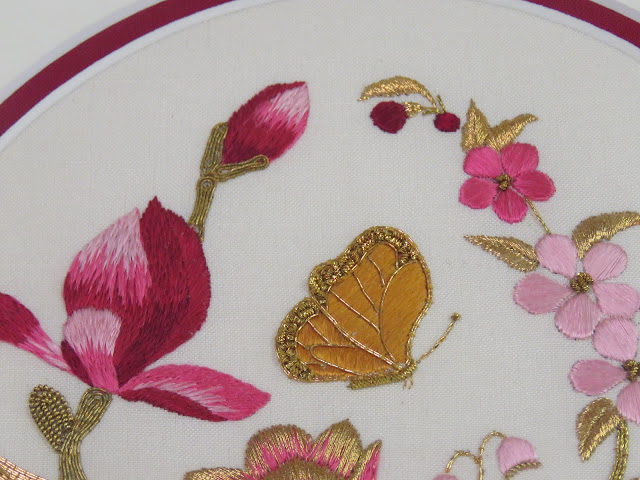
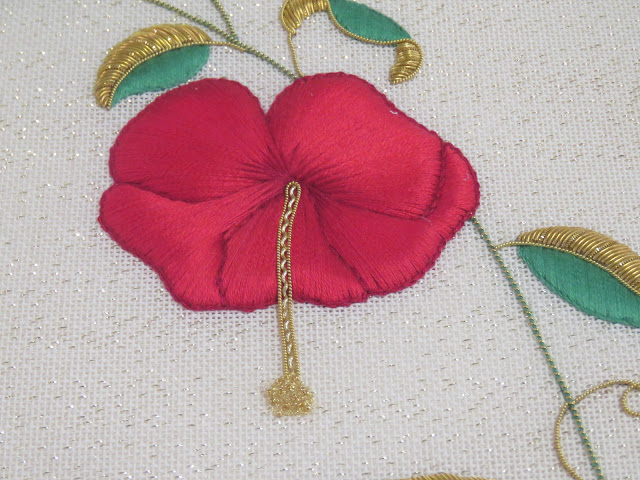
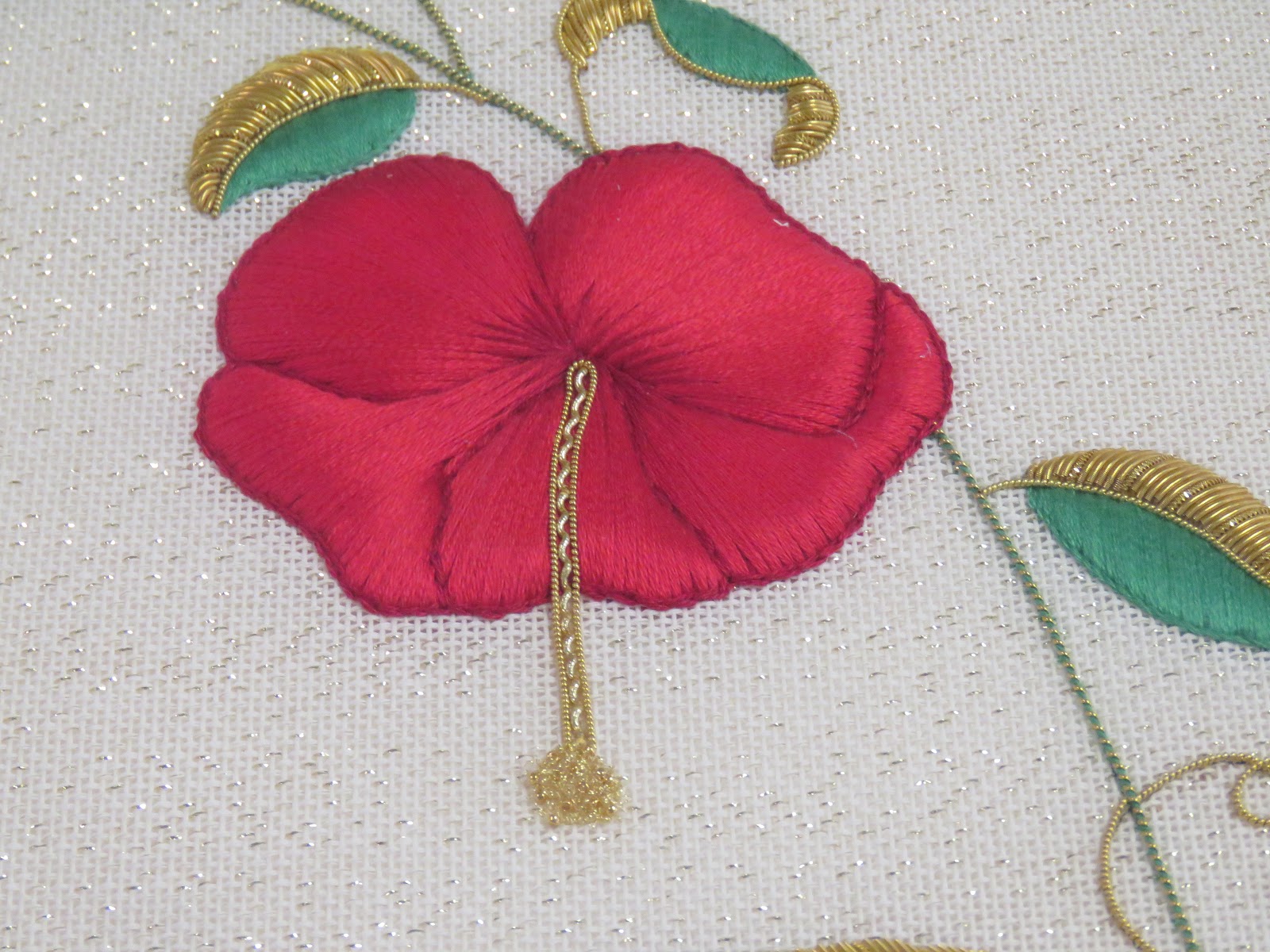
Below as samples of Deborah's work.  Absolutely beautiful  


Gold work doesn't mean the entire piece is stitched with gold.

But it could be...


Thank you Deborah for the informative talk and the beautiful work.

Saturday, April 7, 2018

March 2018 Meeting

I'm a little bit late in posting the March meeting......

Nonetheless, it was a good meeting.


Announcements 


  • Challenge - We will again be keeping a running list of completed projects for 2018.  At each meeting, the notebook will be circulated for your entries.
  • Woodlawn - Their annual exhibit ran the month of March.  Go to their website for a list of this year's winners. (http://www.woodlawnpopeleighey.org/annualneedleworkshow/)  
  • Yahoo mail - If you are still unsure if you are getting our emails or you know someone who isn't, please check your spam/junk mail folder.  Some mail services block Yahoo emails and instead the email goes into spam.   DVHGS is not notified these emails are not getting to inboxes.   Please reach out to Caryl C. at a meeting if you are still experiencing an issue.  Caryl sends meeting reminders the Sunday before our monthly meetings and sends out the newsletter within a day or two of the meeting.
  • The DVHSG Spring Retreat will be the last weekend in April.   This is a MEMBERS ONLY function.  The deadline to register was March 10th. 
  • Penn Dry Goods Market - This year's event is May 18 and 19 at the Schwenkfelder Library. Check out the website for details. (http://www.schwenkfelder.com/Penn-Market/
  • May - June   The Biggs Museum in Dover, DE will host an exhibit from May 19th through June 22.   On June 9th, there will be a symposium.  Here is the link to purchase tickets for the symposium (http://prod5.agileticketing.net/websales/pages/info.aspx?evtinfo=73412~03e13765-2c69-4555-9f98-2b887bde4199&epguid=8dad5a50-5b7f-490a-acea-53bc57307486 )   
  • Louden Sampler Guild - Louden will host the Royal School of Needlework.   This will be the first held in the United States (other than seminars in Williamsburg).  There will be two one-week sessions.   July 8-14 and July 15-22.   There will be a variety of courses, exhibits, programs and events.  Please check their website for more information (https://www.royal-needlework.org.uk/content/1215/rsn_summer_school
  • Lancaster Fiber Festival - The festival will be August 16 -18.  See their website for more information on the event and classes.  http://lancasterfiberfestival.com/about-lff/ 
  • Rehoboth Museum Exhibit - The show has been moved to the fall of 2018.  More information will follow on the dates.   
  • Williamsburg - Christmas in Williamsburg is the first weekend in December.  Please go to the Just CrossStitch website for more info.  https://www.just-crossstitch.com/seminar/index.php  


Red Band Sampler

On Facebook, many are following th year-long project from Carol of iStitch Designs.   This year is the Red Band Sampler.  You can join the group with no obligation to stitch the project.   It is fun and inspiration to see the different interpretations stitchers are doing.   If you wish to join in, the cost is $27 and the next section of the pattern is emailed each week throughout the year.  The fee covers the pattern only.  Carol is based in the UK.   In the US, Sassy Jack's Stitchery carries the banding. 


Stitch-a-long
For those participating in the Lauren Sauer Stitch-a-long, you should be on rows 13 to 17.  here are some hints.
- You may run out of Forest Glad so you may want to use this thread for the dividing bands only.  You could also substitute a stitch other than the Montenegrin stitch as it uses a lot of floss.
- Row 8 - The buttonhole wheels use the same stitch sequence as an Algerian Eye.  You will have to catch the thread when yo come up for the next stitch.
- Rows 16 to 20 - If you stitch the flowers first, i will make it easier to place the stem stitch.  You can substitute the whipped backstitch for the stem stitch if you prefer.
- Schedule for the rest of the year:
o   April-May                      18-21
o   May-June                      22-24
o   June-July                      25-28
o   July-August                   29-32
o   August-September        33-36
o   September-October      37-40
o   October-November       41-44
o   November-December   45-48
o   December-January       49-52        


PROGRAM

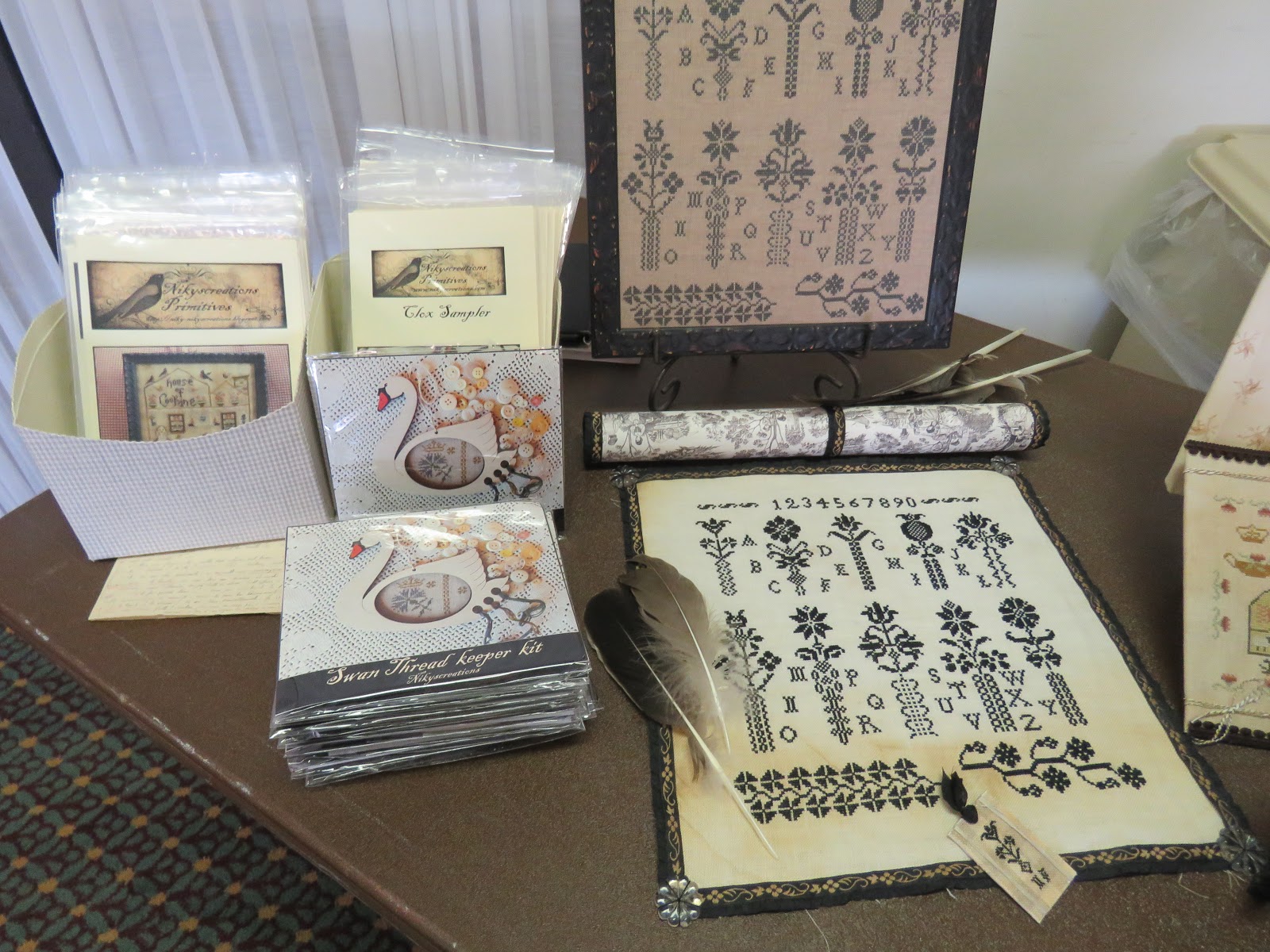
Our guest speaker was Niky Farrauto of Niky’s Creations.  She gave us a little history of her stitching and life as a young girl.  After a hiatus from stitching when raising her children and teaching dance (she is a classically trained dancer and ballerina.), she found her way back to stitching.   She loves antique samplers and researching their history.After stitching models for designers,  she was encouraged to start her own company. And the rest, shall we say is history.  Her designs are primitive—using soft colors and simple designs.


It was interesting to learn of the difficulty in getting floss, fibers and linens in Europe.  She still lives in the small village north of Milan not far from Switzerland where she grew up.  She finds inspiration for her designs in travels.  She also hand-dyes her own fabric. She likes to design flowers, nature and houses. She feels the worst part of being a designer is not having the time to stitch her own designs or other people’s designs.  She does run a club with kits throughout the year. She has a website (www.nikyscreations.com). Her blog address is http://niky-nikyscreations.blogspot.com/. She does run a yearly stitching club and information about the club is on her blog. She also has an Etsy shop. 


For members who signed up ahead of time, Niky taught a class in the afternoon--the Italian Flower Pot Needleroll. 


And now our picture walk of Show n Tell

 And since it took me so long to get my act together and post, my apologies if I label any pix incorrectly.  
Redwork piece stitched by Ann S. 

Stitched by Kathy R.

Stitched from Cricket Collection, stitched by Kathy R.

Basket of strawberries stitched by Jean T.  These are the 12 days of Christmas

Stitched by new member - Lindsey
Also, stitched by Lindsey

Stitched by Cinda

Sojourner, from Heart's Ease Exemplar, stitched by designer (and member!) Theresa B.


Beautiful work from Patric B.

Stitched by Lindsey


Hannah Pepper Sampler, stitched by Theresa B.

An adaptation from a design by Samplers Revisited, stitched by Theresa B.

The tray (one of Niki's designs) and needle book, stitched by Francine C. 
 The basket tag, carrier, squirrel and heart, stitched by Robin T.


 Next meeting - April 14th.   Join us display and talk by Cynthia Symanski about her sampler collection.  

June 2026 Meeting