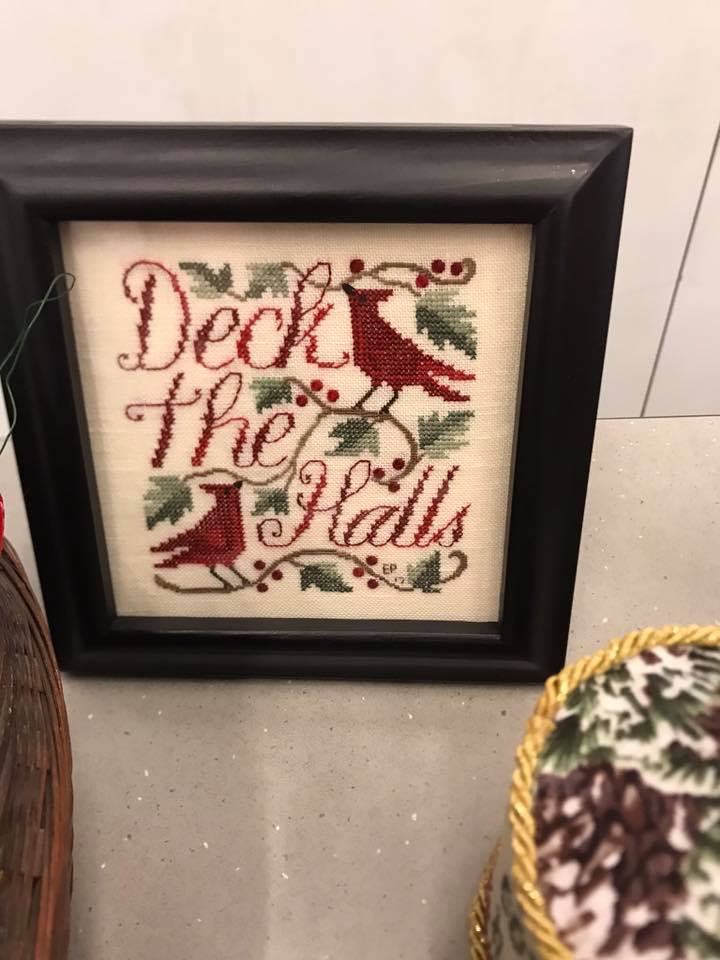
DVHSG May Meeting
- Announcements - 2018 Challenge - the book was circulated for members to add to their individual page the list of completed WIP's. At the end of the year, members with the most completions will be recognized.
- The Treasurer reported we have received another $400 from sales at Fireside.
- Stacy was given a round of applause for coordinating yet another great retreat at Salty Yarns. Next retreat, next October. More details will follow.
- Facebook suggestion - Each member was challenged to add their work for the week with a post each weekend. It will be both fun and dangerous to watch others progress and to see what others are stitching - that's the dangerous part! See it/want to do it!
- Check out our own Deb E. and Liz C. on FlossTube. They post under the name of Country Stitchers each Thursday.
- Conservation Fund - A portion of member dues goes towards our Conservation Fund. Last year we were able to donate $1,000 each to three deserving groups wishing to conserve a piece or pieces of needlework. If you know of a deserving group that would like to be considered, please direct them to the Conservation tab above. Applications are due by August 31, 2108. The Committee will meet to review and make a recommendation. Awards will be made before the end of 2018. If you'd like to help the committee, please contact Ann S.
- Band Sampler Stich-a-long - Marnie shared her progress on the band sampler. She is at row 49 of 52. Marnie has recharted the rows where there were differences between the chart and the photo. Caryl C. will include those changes in the newsletter.


- Penn Market Days is next weekend. In conjunction with the Schwenkfelder Museum in Pennsburg, PA it is a great weekend of exhibits, antiques, market place, lectures and classes.
- During Show and Tell, Patrick shared a laying tool he used to level stitches. He called it an "afcot" (?). A member said they were available at Lacis.com While Lacis.com is a fabulous site for needlework tools, I didn't see an afcot (?).
- June - The Biggs Museum and Symposium in next month. Sign up in advance for classes and lectures.
- July - Member Pat Y. will bring her collection of stitched angels. Members are encouraged to bring any angels they have stitched as well.
- August - The Annual Stash Re-Distribution meeting. Remember, it is optional to donate part of any sales to the Conservation Fund. It is also optional if you wish to send any of your remaining items to Fireside for eBay sales to benefit the DVHSG treasury.
- September - Liz C. will teach peyote beading.
- October - Francine and Marnie will share their collection of marc-lite wear(? - not sure how it is spelled!)
- November - to be decided
- December - Annual Holiday Luncheon and Exchange
Show and Tell
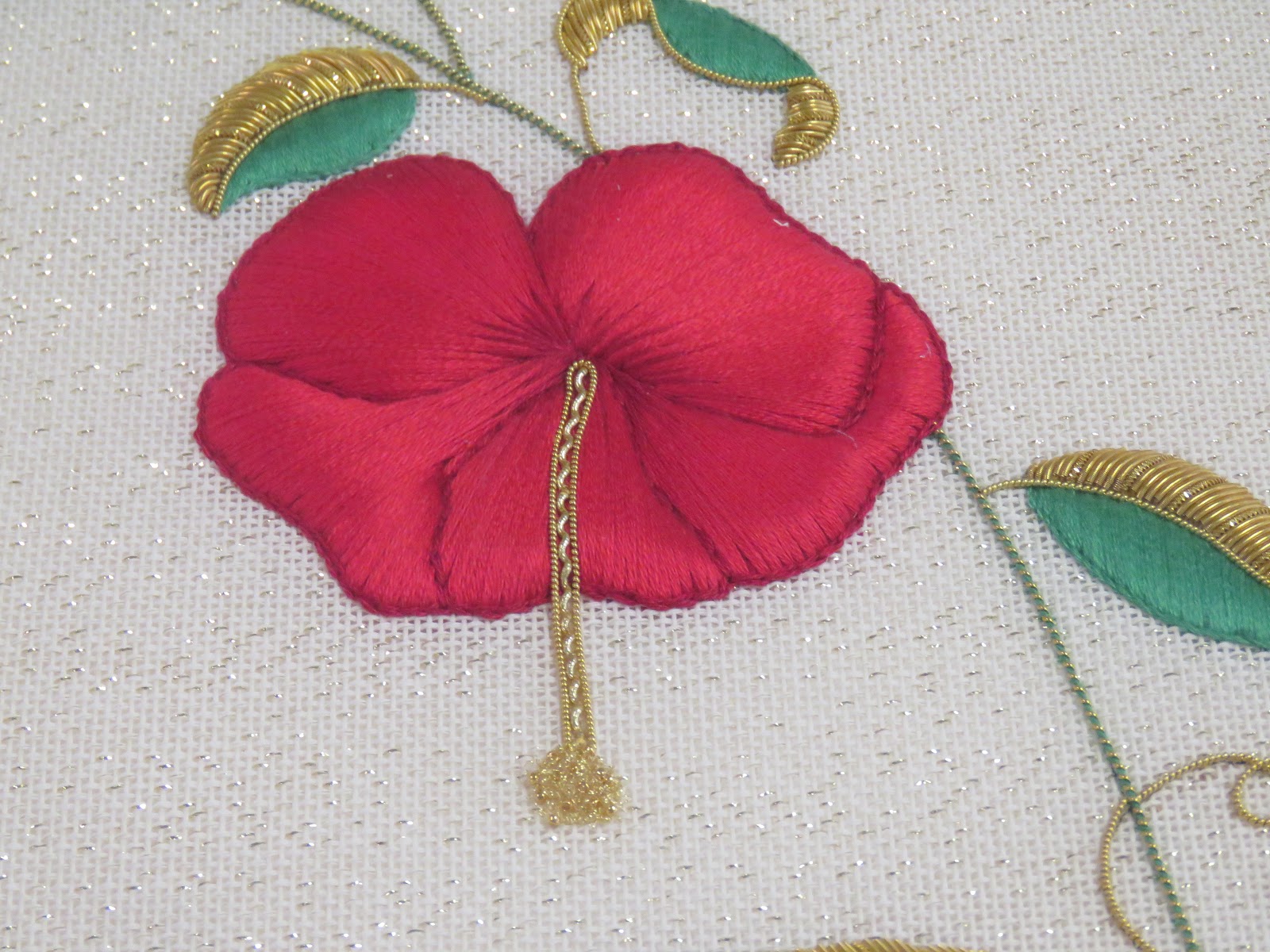
Members brought in their gold work finishes to share. Many (or maybe all) are designs of guest speaker Deborah Merrick Wilson.



 Other just as beautiful Show and Tell -


From The Drawn Thread


Witchy trio from none other than our Halloween loving Kathy R.


Pillow by Evalyn G. stitched to commemorate her anniversary.

Patrick used the method of fusing your orts to create fabric and created this name tag.


Maybe from Carolyn N......not sure.


Lecture -
We were treated to designer and teacher Deborah Merrick Wilson at our May Meeting. In the morning, she gave a discussion on the history of gold work. During the afternoon, she conducted a class in gold work.
Commonly called "gold work' this is really precious metal embroidery. And although Kreinik has it's place in stitching, gold work should not be confused with what most of us know as stitching with metallics by Kreinik or similar. This is actually stitching with precious metals such as gold, silver and copper that is hammered thin and cut into fiber like strands.
Deborah, who attend the Royal School of Needlework, shared her wealth of knowledge, starting with how at a young age, she saw her Uncle stitched, sparkly crest on his blazer and wanted it. At age 10, her mother took her shopping at Indian sari shops where we bought saris. She would go home and deconstruct the saris for the fibers.
Deborah likes all kinds of stitching but like stitched with dimensions best. She gave us a vast history of gold work. Years ago, people believe 'gold' from the ground was part of the sun and it was to be revered. Cleopatra, as we know, was dripping in gold work. It was found malleable and easy to work with. The English excelled at precious metal embroidery for several centuries. It first became popular in Saxon times on ornamental clothing and on bed hangings. Embroidery was a huge part of English economy. Patterns were part of the culture and many patterns came from the church. Embroidery was a form of expression similar to painting and a way to record history. Men and women alike work embellished clothing based on their social status. There were sumptuary laws in effect which dictated what you were able to wear based on your social/economic status. Only the monarch could wear clothing with silk or gold woven into it. During the mid-evil times, embroidery recognized your heraldry by embellishing the horse trappers, the standards, the banners as well as royalty. The gold and the colored silks made people stand out.
Gold work embroidery was so important that in the 9th century, there were laws against embroidering at night. People were having problems with their sight stitching at night. Gold thread was available through deposits in Wales and through trade.
During the 10th century, designs were created and started to be shared. In the 11th century, William of Normandy invaded England and confiscated the precious metal embroidery. The rest of the world found out that nothing compared to the precision and finery of the English stitching. Their work was sought after from royalty throughout world and brought revenue and advertising to England. The Vatican become the largest customer. At this time they became world famous for the entire world for royalty and for pope.
The skill was so highly thought of that stitchers taught the children of royals embroidery techniques in exchange for parcels of land.
In the 12th century, the precious metals were drawn out into finer and finer fibers to stitch with. Guilds starting to form in 13th and 14th century and were mostly limited to men. The English standard was very high and the guilds were to insure consistency and highest quality of stitching. Most aristocrats has in-house stitchers A great resource in the book, "In Fine Style". It covers the Tudor and Stewart eras and some photos of garments that have survived. The Tudors brought in a time of wealth and knowledge.
Elizabeth the 1st reigned when Shakespeare was writing. A great day trip would be to the Folger Museum in Washington, DC There is a collection of all things Shakespeare which includes 15th through 17th century items. The costumes of the actors in Shakespeare's plays worn costumes with gold work so the actors could emulate the characters they were playing. An actor on stage was exempt from sumptuary law. Wealthy people left their finer garments to churches, trusted servants. Theater companies would buy these garments for their productions. Related, books and bindings were so much a part of the book itself. The bindings were meant to protect the book and the metal work was meant to protect the silk. IT was for durability not be decoration. And of all things, gold work was a precursor to printing. Gutenberg was first an embroiderer before he was a printer. The act of stamping and plying the gold brought able the ability to create letters in these metals for the first printing presses. After Elizabeth's reign came the Stewarts and embroidery changed to a more Jacobean.
English techniques were taught around the world during the 'empire era'. India and other nations become adept at the finer work and England work become more design work.
Gold work does tarnish. It is best to keep it in an acid free setting and protected from the elements. Current gold work stitches now protect their metals by applying lacquer to the threads before stitching. Easier way if you feel you must, is a fine spray with Aqua Net hair spray! You must spray evenly and turn to spray all sides.
In 18h century France, "Drizzling Parties" became popular. Ladies at social events carried drizzling kits consisting of small tweezers and scissors to off small pieces off gold garments. Gentlemen actually started having garments made with loops for the ladies to cut off and keep the garment intact.
And if that is not enough, here is a bit of trivia. Did you now a historical piece of needlework has what is called a light budget? It is the calculated length and number of times a piece can be brought out into the light and not damage a piece.
Below as samples of Deborah's work. Absolutely beautiful

Gold work doesn't mean the entire piece is stitched with gold.


 |