Friday, September 29, 2023

September 2023 Meeting

I was not able to attend the September Meeting, however I am sure we ran through all the normal reports and notices.   What I do know for sure is about the program held at the September meeting.  I had previously participated in a class with Michelle Ink at Jamboree at Salty Yarns,  and I knew all about the process.   

We hosted Michelle Ink Designs for a class in silver making.   What?   It was an introduction to silver alchemy for stitchers.   The options of what to make varied from silver strawberry toppers to needle minders to jewelry.  

Michelle starts the class with her history and her journey.  She then walked you through the process, explaining each step the class would follow and what she, herself, will do after the class.    

Everyone received their clay in the foil package.  The clay had to be worked until it became a creamy consistency.

Michelle had an amazing number of molds to choose from.   The clay was rolled in a ball.  It was then placed in the center of the mold and pressed from the center out.  This was to avoid seams or cracks and to allow the excess silver clay to be pressed off the edges.  A paint brush and small amount of water was used to brush and smooth the edges.  No worries.   There was no waste.  Any extra was removed and rolled into a smaller ball to be used with another mold. 

Because the need to be fired, once each student finished with their molding, their pieces were left for Michelle to take back to her studio.   Michelle painstakingly did fine tuning on each molded piece, smoothing the  edges and rounding out any holes made in the piece.    She then fired each piece.  Polished each piece.  Finally tenderly packaging each class attendees piece and delivering it directly to their home address.   The follow-up process took about 6 weeks which was made clear before the class so everyone realized they would not be walking out with their pieces.

Use your imagination to see how a finished topper fits a strawberry.


Michelle can be found on Facebook at Michelle Ink Designs.

Saturday, September 16, 2023

August 2023 Meeting

Our August Meeting was via Zoom only.   The meeting was called to order by our President Linda D. and following our Committee Reports, etc. our program was launched.

We were treated to the knowledgable and fabulous Jennifer Richardson of Violets and Verses.   She spoke on the Shakers and particularly, the To Emeline Sampler.  So what are “Shakers” you may ask.   They organized in the United States in the 1780’s.  They were first called the “Shaking Quakers” because they actually shook their arms and bodies during singing to cast off the bad thoughts and ill will.  They practiced celibacy and lived in a communal, utopian society.  They were pacifists and believe in the equality of the sexes.  They were known for their simple lifestyle, their thirst for technological innovations, their music, they were avid gardeners saving seeds for the next season and also known for their furniture making.  There is only one Shaker settlement still in existence today and since Shakers are celibate…..well, I need not say any more on that.   

One particular Shaker settlement is the Enfield Shakers, Enfield, New Hampshire.   They owned and  farmed over 3,000 acres.  In Mount Lebanon, NY, they had a successful seed business.   The Shakers were the first to package seeds for sale. They create innovations in marketing seeds, distributing them, packaging and cataloging which lead to lasting change in the horticultural business forever. 

They also did broom making.  On site at Enfield, is a building that is being renovated to house the broom making.     Did you know a good broom will stand up on its own?   Their’s all do.   They sell all the different varieties of brooms they make in the gift shop and they also offer a 3 hour class to make your own broom!

Also onsite, the 1854 cow barn…..mainly full of pigeons now.

In the next building, Shaker clothing is on display as well as The Tempestry Project.


The Tempestry Project started in Washington State in 2017.   Because climate change is always a difficult topic, crafters used their medium to ‘chart’ temperature patterns and changes.  In Enfield, they knitted with worsted merino wool using a key with a different color to represent every degree.  


Done in 10 year increments, they knitted a row to represent the average temperature for each day of one of the years in that decade.

The original site in Enfield had over 100 buildings which included  the “Great Stone Dwelling”. The largest ever Shaker building which now houses the Museum.  Due to declining membership, they were force to sell  property in 1927.  In property was sold again in 1985 by a private group of investors.  In 1997, the Museum was able to repurchase the Chapel as well as other Enfield buildings.  

This is the Chapel on the left and the Great Stone Dwelling on the right.  The Chapel was build on a piece of land that was sold to the Our Lady of La Salette, an order of Catholic priests.


The Museum tour offers some great finds.   Original “Dorothy” cloaks.  Typical construction with hood and cape.   These cloaks have “The Dorothy” labels inside the neckline.  One of a couple different cloak patterns they used.  Using this photo, the scene was re-created in the museum.


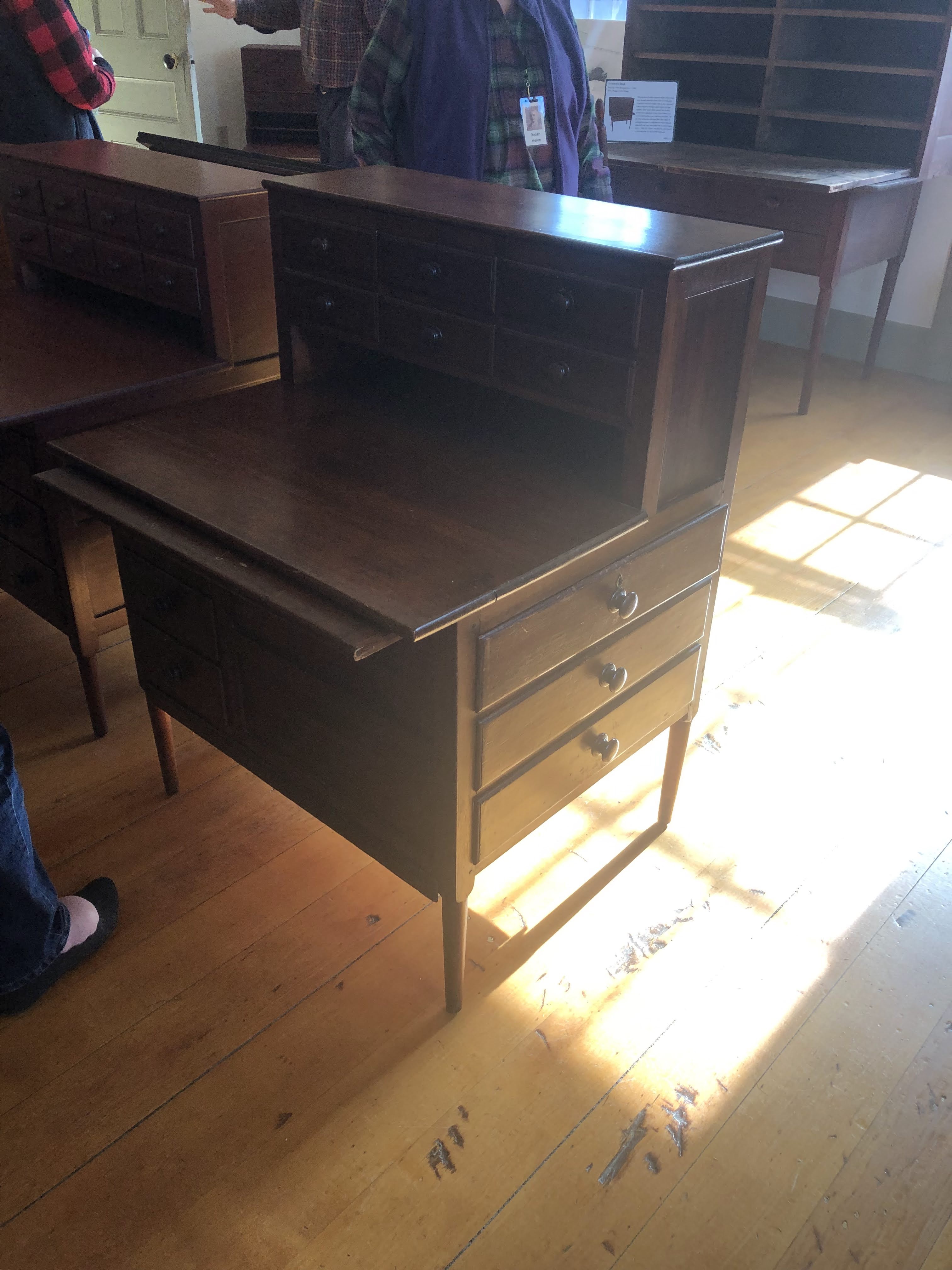
Shaker furniture 

In the Dining Hall there are several examples of perforated paper stitched pieces.
 

Walls of built in cabinetry.  Not a bit of wasted space!
Storage closet for dinner ware.

Shakers set their tables in sets of four so everything was in reach of each diner.  Shakers ate in 15 minutes and there was no talking at the table.   With everything within reach it wasn’t necessary to ask to have something passed to you.

Thick walls and their shutter ‘storage’ built in to the window casing.

The built-ins found in the bedrooms.

So much for a Shaker Village, now on to the project.  
                                                        To Emeline - AW 1847

This sampler is believed to have been given by AW as a token of friendship to Emeline.   Jennifer did extensive research and can determine that AW is most likely Ann Maria Wheeler.   She lived in the Shaker Village for about a year.  She left the Shaker Village near Albany, NY to rejoin her husband in Oswego, NY.  Jennifer admitted the her’s is just speculation as far as the identity of AW.   Emeline, on the other hand, has more information.   She was born in 1793 and lived to be nearly 80 years old.  She is buried in a Shaker Cemetery near Colonie, NY.  Emeline would have had a busy life working various jobs as women played an active role in the Shaker community.  Emeline served in a leadership role as an eldress of the community.  

The original sampler is owned by the Western Historical Society, Cleveland, Ohio.  


Thursday, August 3, 2023

Dedication to a Founding Member

On the last Saturday of July 2023, several members of the DVHSG met at the Salem County Historical Society for the dedication of the Sarah Thompson, 1775 Sampler.  

The Conservation Committee set out to find the perfect sampler to conserve in honor of one of our founding members, Patti Hrynenko.   Patti was a great asset to the south Jersey sampler world.  

Her love of historic needlework started long before the guild. Patti had a long-term affiliation with the Gloucester County Historical Society where she dedicated her efforts to seeing that their collection of samplers did not remain in storage. She spent countless hours researching the girls who stitched these samplers and was able to tell a story about each one.  She has charted several of them with the proceeds from sales benefitting the Society's Sampler Collection Designated Fund to b used for the continued preservation of samplers in their collection.The first sampler she charted was Lucy Hugg, in 1999.  This same sampler would become the Guild's first stitch-along.  There are six samplers available on the Gloucester County Historical Society website.   Many of us enjoyed the tours she lead at the Gloucester County Historical Society.  

Nine of the pieces in the Society's collection were included in the 2014-15 New Jersey Sampler exhibit at the Morven Museum, and can be seen in the exhibit catalog- "Hail Specimen of Female Art". The 1788 Sybil Tatum Quaker medallion  catalog- "Hail Specimen of Female Art". The 1788 Sybil Tatum Quaker medallion sampler was included in Carol Humphrey's book, "Quaker School Girl Samplers from Ackworth".

Patti's contributions to our Guild over the years were many, including private tours of the Gloucester County sampler collection and other textile exhibits.  A favorite memory is the fabulous talk she gave when we celebrated the Guild’s 20th Anniversary in 2022 - delayed for two years because of Covid.  It was full of history for the new members and fun memories for the veteran members. 


Sarah Thompson Sampler, age 10, 1775

Many thanks for the Conservation Committee for their work and to Marnie B. for the wonderful tribute she made, part of which I used to create my comments above. 


Those who attended the dedication had a chance to tour the museum while there. 


The museum is located in the Alexander Grant home, erected in 1721, with portions erected in 1690.  The building itself has a lot of history.   In addition to being a family home, it once was a temperance hotel and also medical offices.   In 1850, John S. Rock, studied dentistry here.   Mr. Rock was the first African-American attorney admitted to practice law before the U. S. Supreme Court.  

Above, the Alexander Grants House, Col. Robert Gibbon Johnson, 1821 and the Salem Oak - all from the Cat’s Meow Collection of Salem County


Directly across the street from the museum are the courthouse steps where Col. Johnson took a bite out of a “love apple” or  tomato and did not die!   

SALEM OAK
This area is rich in history and the Salem Oak is part of that history.   This large oak tree is the site where John Fenwick signed a treaty with the Lenni Lenape Indians in 1675 when he arrived and founded Salem, NJ.   The oak was over 600 years old.  It is believed to be part of the original forest that was part of John Fenwick’s land.    It measured 22 feet in circumference and stood over 100 feet tall with a span of over 104 feet.   It was located in the Salem Friends Burial Ground in Salem NJ, before is just fell over one day in June of 2019.  Before that it was one of NJ best-known trees and ranked among the largest white oak’s on NJ.  


Other notable history for Salem County is that Betsy Ross used to summer in Mannington, NJ just a few  miles from the Alexander Grant House. 

The chair below it believed to have belonged to William Penn.  Although mainly associated with Philadelphia and Pennsylvania, William Penn had many ties to Salem County.  The chair was brought from   Philadelphia in the 1870’s by Jesse Bond, a respected Quaker School Teacher.  His family were friends of the Penn Family.


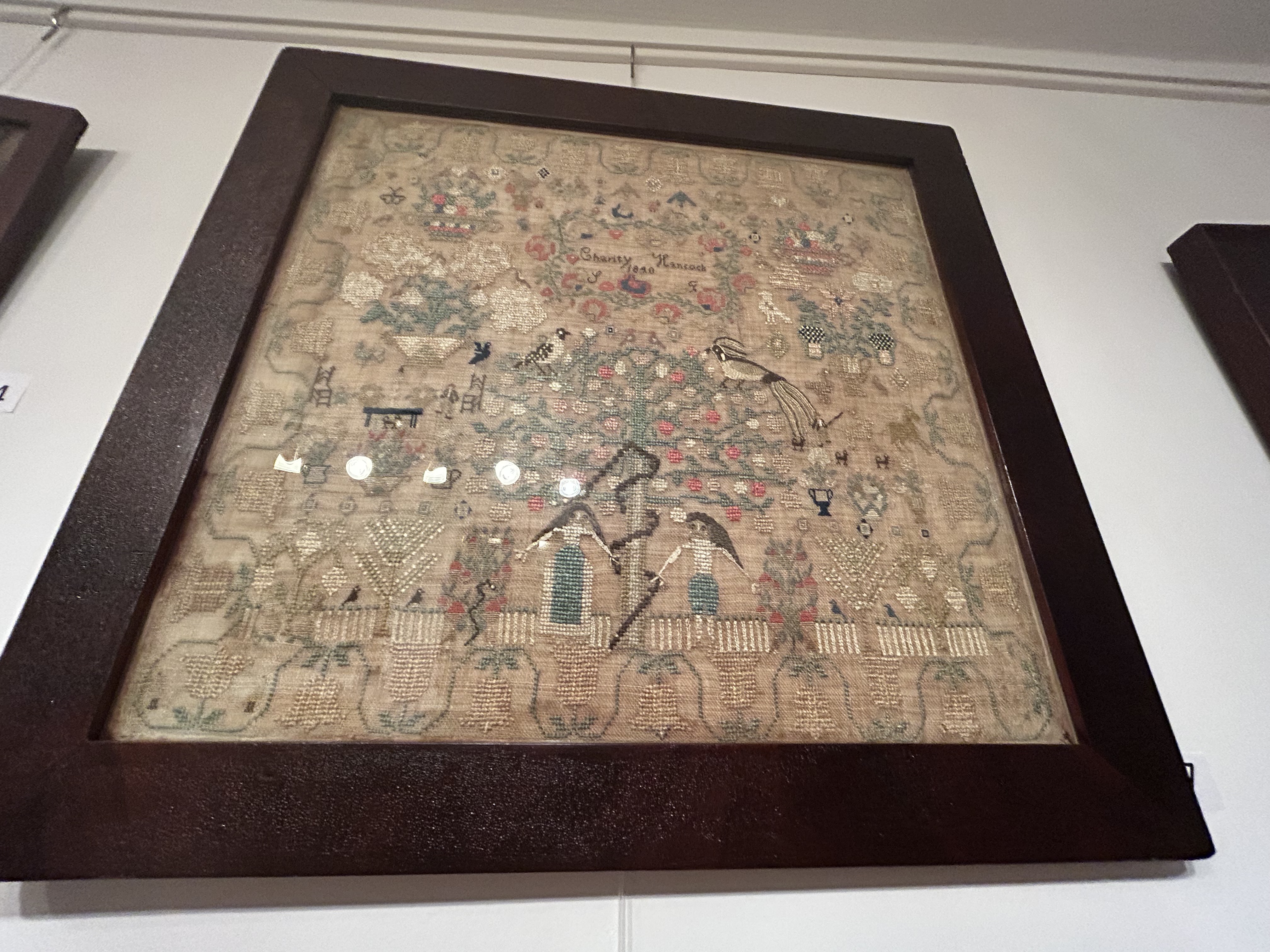
 For a small historical society, there had a lovely collection of 30 to 35 samplers.  

Another early sampler from the collection is this alphabet sampler. It is signed “EB”.   The stitcher is unknown.  The sampler is dated 1793.

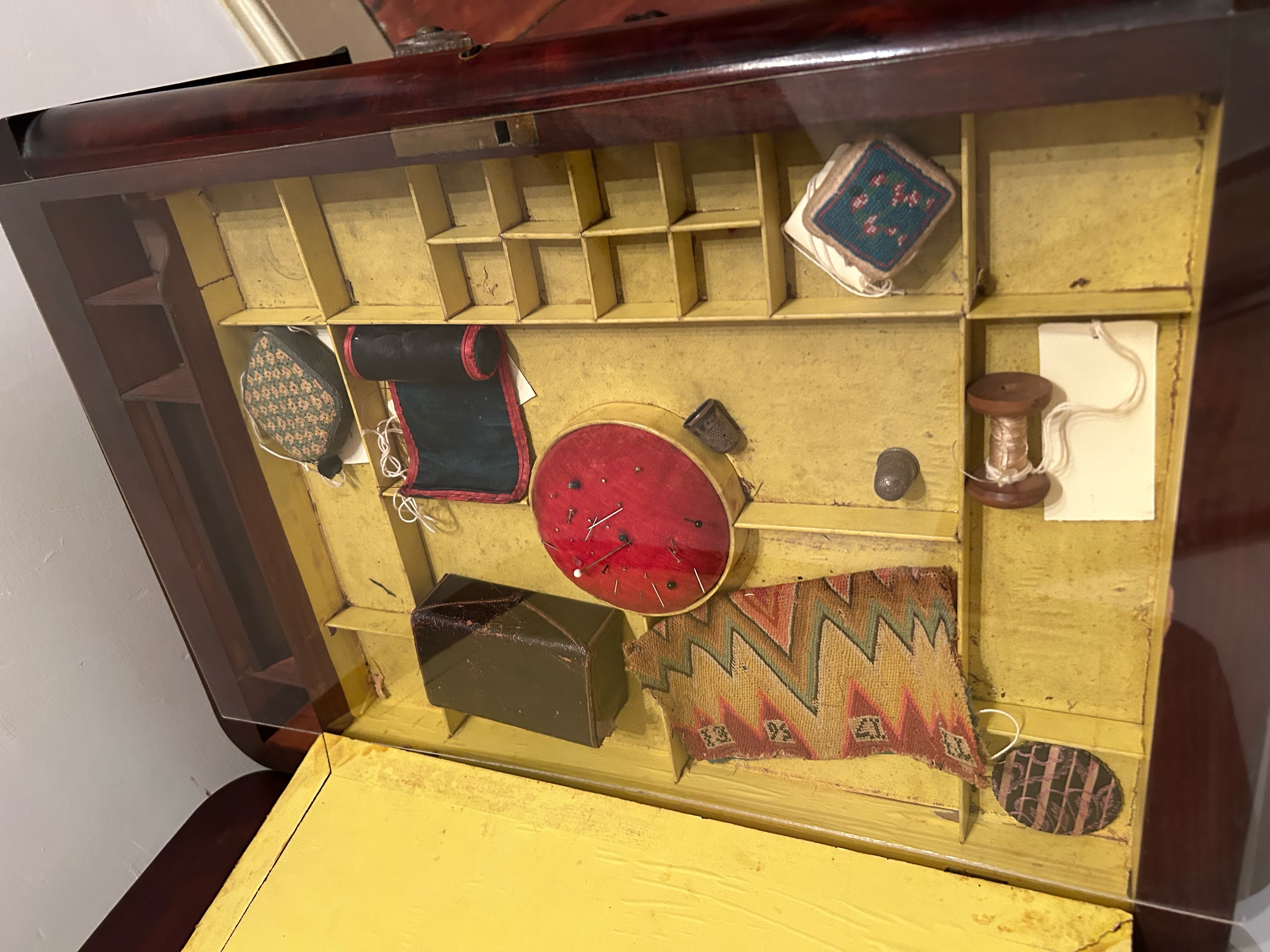
This lovely sewing stand was located in the sampler room.


Mary Tyler, Westtown Sampler, 1820

Elizabeth Fogg sampler, 1846

Eliza Gamble, 1848 Sampler


Sampler and painting.


Elizabeth Goodwin, a Westtown Sampler, 1820

Hannah Abbott sampler


Mary Jane Williams, 1840’s

Lydia Fogg, 1835

Peyote bag, undated

Margaret Denn, 1829


GLASS WARE
Salem County was the ‘cradle of glass” in America.  Casper Wistar, from Philadelphia, started a glass factory in Alloway in 1738.  They produced window panes, bottles and other glass containers for the next 40 years.  In the mid-19th century the local industry employee 24,000 employees.  (2023 census puts the current population of the county at 65,000). Operating several  glass factories:  Wistarburg Glass, Gaynor Glass Works via Holtz, Clark & Taylor,  Salem Glass Works, Quinton and Elmer Glass works as well as Anchor Hocking.

Large scale production of glass is no longer done in Salem, however, Salem Community College  offers degrees in glass blowing a glass artistry at a much lower cost than it’s rivals of Rhode Island School of Design and Tulane University and provides the nation’s only degree program in scientific glass blowing.  


Samples of glass from the Wistarburg Glass Works


Canton China, from the Port of Canton, China.  Imported for 400 years, up to the 1940’s.   Collection of local resident donated to the historical society. 

On the lower shelf, silver sugar tongs from the early 19th century by local silversmith Charles Ramsey.

What a crazy claim to fame….glass coffins!?

NOBEL PRIZE WINNER
More 20th century history is Salem had its very own Nobel Peace prize winner.   Mr. Charles J. Petersen was awarded Ed the Nobel Prize in Chemistry in 1987.   He won jointly with Donald J. Cramer and Jean-Marie Leon for “their development and use of molecules with structure-special interaction of high selectivity.”


Madame Duval’s Cameo Collection.  

Local resident, Sarah Hancock Sinnickson was the daughter of Judge Willam Hancock. Killed in the Hancocks Bridge massacre, March 21, 1778.  She was married to Captain Thomas Sinninckson of the Caleb County militia.   During the Revolutionary War, her home was occupied by the British and her husband forced to serve or suffer imprisonment and lost of land and all property.   The dress below is the dress Sarah wore to the inaugural ball for  George Washington as President.


QUILTS
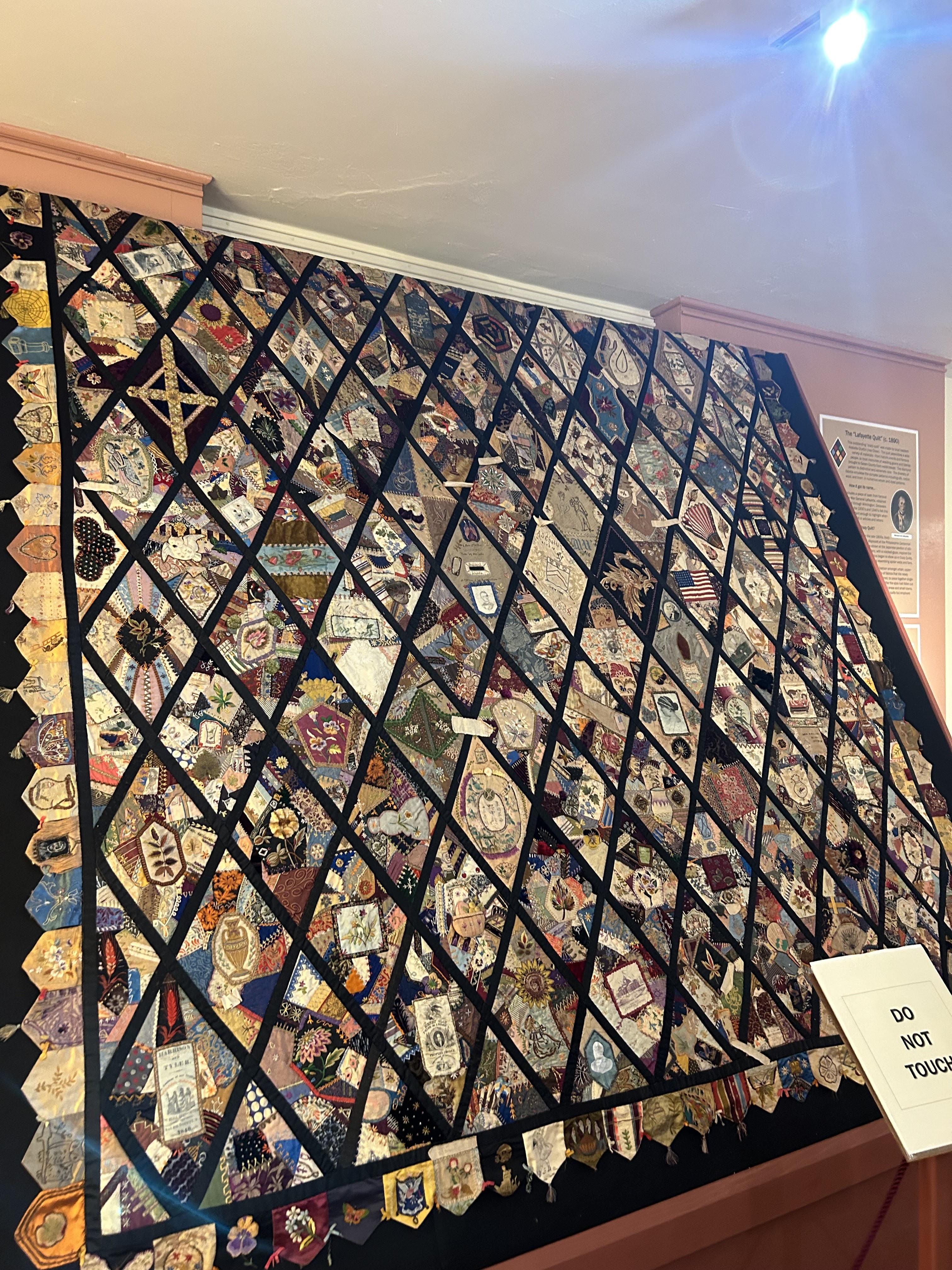
Outstanding “crazy quilt”.   Also known as the Lafayette Quilt, 1890.  It is called the Lafayette Quilt because there is fabric from Revolutionary War General Lafayette’s sash in the quilt.


This museum packed a lot into its humble space and much more than I have shared here.    Soon to open is a room that will be dedicated to all things children - toys, beds, clothing, etc.   


June 2026 Meeting